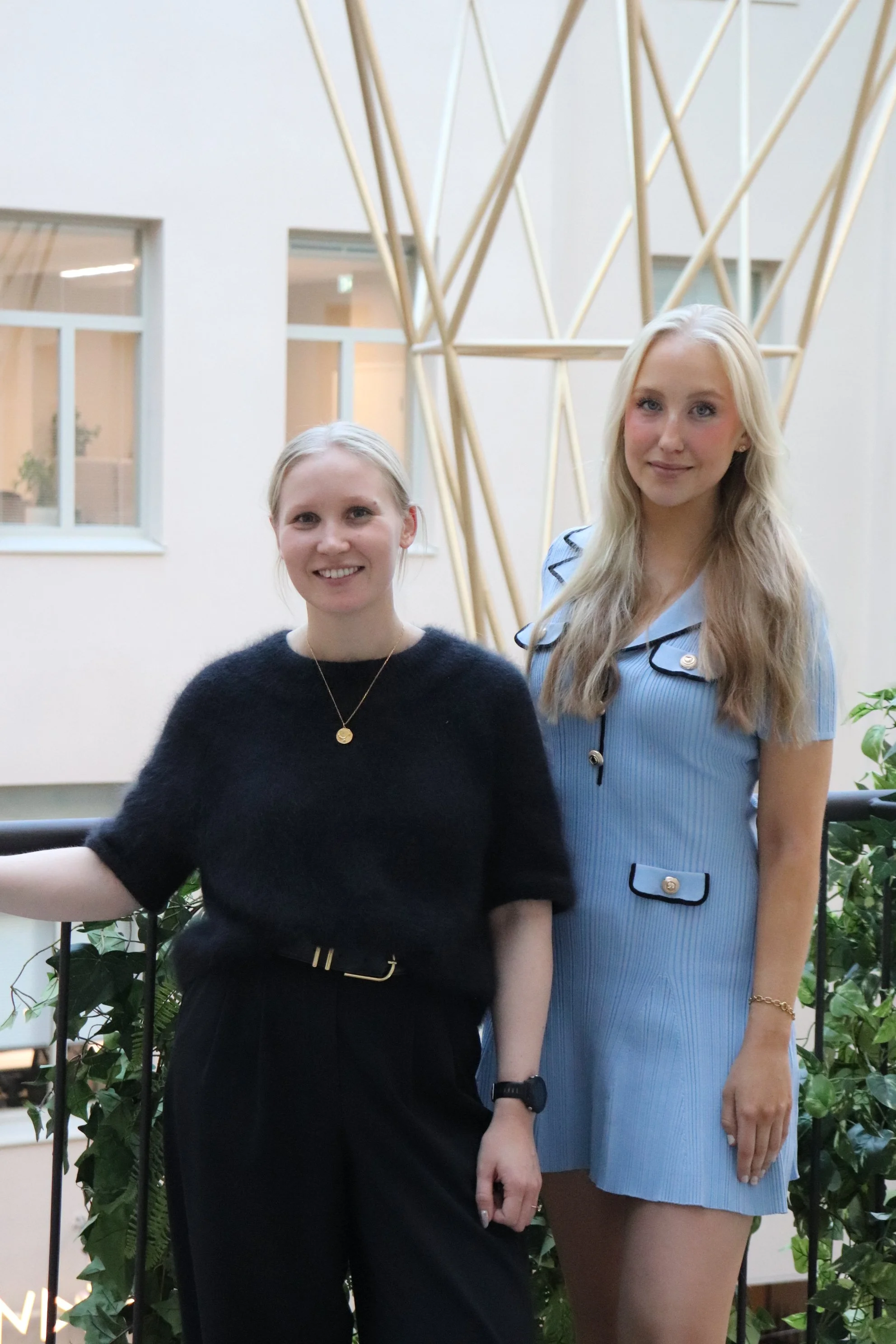
Meet Noora Räsänen, Senior Investment Associate and Petra Seppälä, Investment Analyst, at Urban Partners.
Both studied at Aalto University, but their paths into the industry have been different. Noora joined Urban Partners as an Investment Analyst almost six years ago, while Petra joined a little over a year ago, bringing previous experience in real estate investments.
In our conversation with Women’s Career Society, they share what drew them to the industry, what they’ve learned along the way, and why you don’t need to have everything figured out before you start.
Finding your own way into the industry
Neither Noora nor Petra had their entire career mapped out during their studies. Their interests developed through experience, exposure to different areas of business, and discovering what kind of work suited them.
For Noora, an internship at Urban Partners helped turn an initial interest into a clearer career direction. Petra’s experience in advisory work and investments, meanwhile, gave her a broader view of the industry and helped her realise that she wanted to work more directly with investments. Their experiences show that choosing a career isn’t always about knowing exactly where you want to end up. Sometimes, you find your direction by trying different things and paying attention to what interests you.
Investment work also offers plenty of variety. Rather than looking at each project in isolation, the team considers the bigger picture and follows how investments develop over time. This means understanding not just the decisions being made, but also their potential long-term consequences.
More than just numbers and spreadsheets
Investment work is often associated with financial models, calculations and detailed analysis. Those skills matter, but there’s much more to the job. Understanding an investment also means understanding the market around it, asking questions, considering different perspectives and working with people both inside and outside the organisation.
There isn’t always one obvious answer to a problem. Reaching a decision involves weighing alternatives, challenging assumptions and being willing to reconsider your view when new information comes along. Analytical thinking matters, but so do communication, collaboration and understanding other people’s perspectives. You need to be comfortable with numbers, but also willing to look beyond them.
As Petra explains, curiosity and a willingness to learn are essential, especially in a team where people bring different kinds of experience.
“I think one of the most important qualities in this field is the ability and willingness to learn new things. People come from very different backgrounds, and nobody expects you to already know everything. What matters is being curious, wanting to learn, and being able to connect information from different sources.” - Petra Seppälä
People skills are important, too. Much of the work involves coordinating different stakeholders, keeping projects moving and bringing different perspectives together. For anyone considering a career in private equity, there’s more than one way to contribute. Technical knowledge matters, but curiosity, problem-solving and a willingness to learn are just as valuable as you develop in the role.
You don’t need to know everything before you start
Starting a new job can make it feel as though everyone else knows more than you do. You might hesitate to ask a question that seems obvious or share an opinion before you’re completely sure of it.
Both Noora and Petra reflect on how their understanding of work has changed with experience. You can’t know everything from the beginning, and you’re not expected to. Much of the learning happens once you start doing the work, encounter unfamiliar situations and ask questions along the way.
At Urban Partners, working in relatively small teams can also mean taking responsibility early on. That creates opportunities to learn by doing, even when a task initially feels outside your comfort zone. The key isn’t to pretend you have all the answers. It’s to recognise what you know, understand what you still need to learn and make use of the people around you.
There’s value in speaking up, too. A question or a different perspective can lead to a discussion that might not otherwise have happened. You don’t have to be the most experienced person in the room to contribute something useful. Being curious means being willing to explore what you don’t yet understand, and that mindset remains useful long after your first years in the industry.
Taking responsibility early and learning from others
Taking on responsibility early in your career can be exciting, but it can also feel like big step. Noora recalls being involved in expanding the business beyond its domestic markets. Working in a relatively small team gave her the opportunity to help build networks and establish contacts in new markets, even when the responsibility felt ambitious at first.
Experiences like these can change how you see your own abilities. You may not feel entirely ready when an opportunity comes along, but being trusted to contribute gives you the chance to discover what you can do. That doesn’t mean you have to figure everything out alone. One of the important lessons from the conversation was the value of drawing on the expertise of the wider team, rather than feeling that you must solve every problem yourself.
“As I’ve grown in my career, I’ve come to realise that learning never really stops. There will always be something new around the corner, and I’ve learned to embrace that as part of the journey.” – Noora Räsänen
Support can come through discussions and brainstorming with different stakeholders. As your responsibilities grow, so does the need to understand when to take the lead and when to lean on others. Becoming more experienced isn’t just about working independently. It’s also about knowing how to bring different strengths together.
Learning to look at the bigger picture
Early in your career, it’s natural to focus on the details. You want to understand how things work, get the analysis right and make sure you haven’t missed anything important. That attention to detail is valuable, especially in investment work.
With experience, though, you begin to see the importance of stepping back. How does your work fit into the wider project? What matters most for the decision at hand? What does the rest of the team need to move forward?
Noora describes this as learning to step away from the details now and then and look at things from a different perspective.
“Lately, I’ve been learning to step back and look at the bigger picture. There’s a famous metaphor about also being able to step onto the balcony and look down at the dance floor, rather than spending all your time on the dance floor yourself. For me, it’s about letting go of the small things, thinking ahead and being open to changing your perspective.” - Noora Räsänen
For Petra, a major lesson has been realising that she doesn’t have to know everything herself. Learning to ask the right questions and draw on her colleagues collective expertise has been an important part of growing into her role.
That also means becoming more comfortable with uncertainty. Investment decisions are made based on the information available at the time, and the outcome won’t always be what you expected. Markets change, new information emerges and assumptions sometimes need to be reconsidered.
What matters is thinking carefully about a decision, understanding the reasoning behind it and being open to learning from what happens next. Having a strong view can be useful, but so is knowing when to change it. Over time, seeing the bigger picture becomes just as important as understanding the details.
A team where different perspectives matter
Another theme in the conversation is the value of working with people who approach problems differently. Everyone brings their own experiences, knowledge and ways of thinking. That can lead to questions and ideas that someone else might not have considered.
For someone starting out, speaking up can take confidence, particularly when others have more experience. But being new can also mean seeing something with fresh eyes. You don’t need to dismiss your ideas simply because you’re still learning. Listening to others and sharing knowledge can lead to a better understanding of a problem than trying to solve it alone.
Both Noora and Petra highlight the importance of an environment where people support one another and feel comfortable sharing their ideas. A good team isn’t built only on individual performance. It also depends on how people work together, share what they know and help each other succeed.
What would they tell their younger selves and students who are interested in the field?
Looking back, Noora’s and Petra’s advice comes down to staying curious, trusting yourself and not comparing your progress too closely with other people’s. If an opportunity interests you, give yourself a chance to explore it. You can learn a lot by taking that first step, even if you don’t feel completely ready.
Petra knows how easy it is to talk yourself out of an opportunity before you’ve even tried.
“I’d say don’t compare yourself to others. Trust that you have something valuable to offer just as you are, while staying open to learning new things. There were internships I didn’t even apply for because I didn’t think I was good enough and assumed other applicants would be much better than me. Looking back, not trusting yourself can be a much bigger loss than taking a chance and sometimes failing.” - Petra Seppälä
It’s easy to assume that everyone else has a clearer plan or feels more prepared. In reality, careers rarely follow a perfectly straight path. Your interests may change, your perspective may shift, and skills you develop in one role may turn out to be useful in another.
For anyone considering a career in private equity, Noora and Petra’s experiences offer a reassuring reminder: you can start without knowing exactly where you’ll end up. Just stay curious, ask questions, trust yourself enough to take opportunities and give yourself room to grow.